
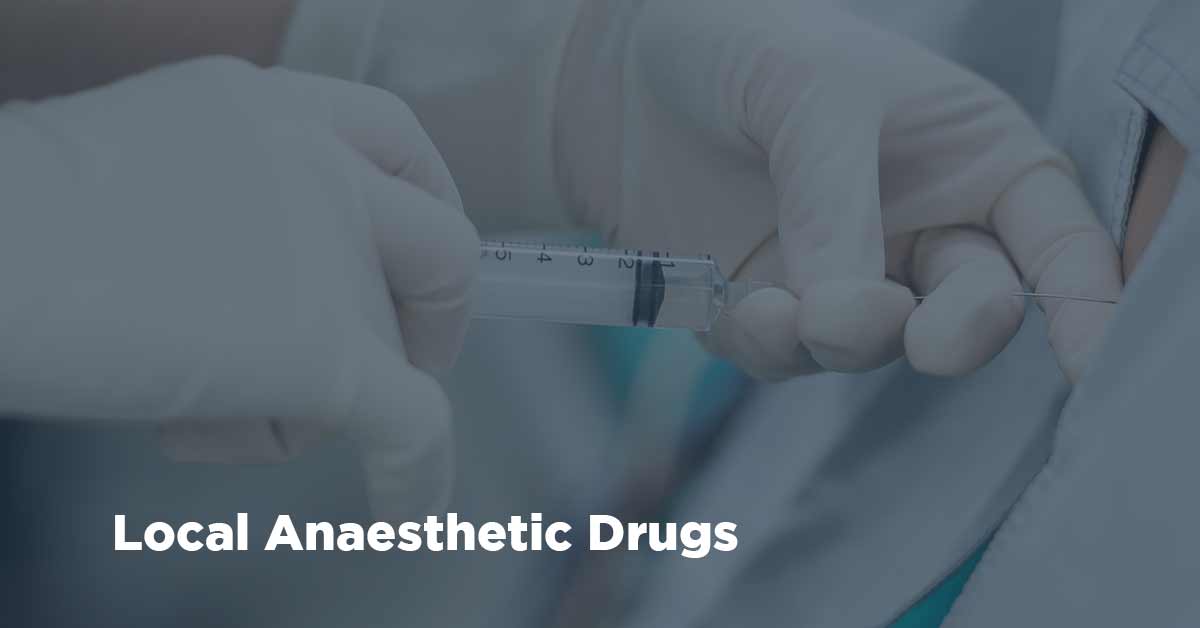
Local anaesthetic drugs reversibly prevents transmission of the nerve impulse in the region to which it is applied, without affecting consciousness. It is applied in dentistry, spinal surgery, etc.
Local anaesthetic drugs provide anaesthesia and analgesia both intra- and post-operatively. They are applied locally and block nerve conduction of sensory impulses from the periphery to the CNS. At high concentration, it blocks motor activity
The first used local anaesthetic drug was cocaine, and it was introduced as an ophthalmic anesthetic in 1884. Despite the issue of addition and dependance, it was used for 30 years as the only available local anaesthetic agent. Einhorn synthesized procaine in 1905, and it became the dominant local anaesthetic drug for the next 50 years.
Lidocaine, the most used local anaesthetic drug to date, was synthesized in 1943 and introduced into the market in 1948 by Nils Lofgren.
Newer local anaesthetic agents have better patient profile (minimizing systemic cardiac and central nervous system (CNS) toxicity, reducing local tissue irritation). It also improved the onset and increased the duration of action.
Mechanism of Action
Local anaesthetic drugs block voltage-dependent sodium channels and reduce the influx of sodium ions, thereby preventing depolarization of the membrane and blocking conduction of the action potential.
Local anaesthetics when injected into infected tissues are less effective as smaller percentage of the local anaesthetic drug is nonionized and available for diffusion across the membrane in an environment with a low extracellular pH.
Acidosis which is caused by inflammation reduces the action of local anaesthetic drugs. This is partly because most of the anesthetic is ionized and cannot cross the cell membrane to reach its cytoplasmic-facing site of action on the sodium channel.
Addition of Vasoconstrictor to the Local Anaesthetic Drugs
Vasoconstrictors include adrenaline (epinephrine), felypressin, and levonordefrin.
For drugs with intermediate or short durations of action such as procaine, lidocaine, and mepivacaine, vasoconstrictors are important in prolonging the anaesthetic action. This is unlike in lipid-soluble drugs with long duration of action like bupivacaine and ropivacaine, where the molecules are highly tissue-bound.
With the exception of cocaine, most local anaesthetic drugs are vasodilator, and the addition of a vasoconstrictor can help to increase the duration and quality of anesthesia, reduce bleeding, and decrease the amount of drug reaching systemic circulation.
However, vasoconstrictors are contraindicated in diabetes, heart disease, pregnancy, hyperthyroidism (toxic goiter).
Apart from the vasoconstrictors, other compounds like bicarbonate and glucose can be added to the local anaesthetic drugs. Bicarbonate is added to a local anaesthetic to increase the pH of the environment when administered. This means more drug is present in its unionised form increasing the speed of onset of anaesthesia. However, high level of bicarbonate may result in precipitation of the local anaesthetic as the unionised form is much less soluble in water than the hydrochloride salt.
Glucose is added to bupivacaine in order to increase the baricity of the solution to greater than that of CSF. This result in more controlled spread of solution within the intrathecal space during spinal anaesthesia.
Classifications of Local Anaesthetic Drugs
Local anaesthetic drugs can be classified as amide or ester. The bond between the lipid-soluble, hydrophobic aromatic group and a charged, hydrophilic amide group determine the classes.
Tetracaine, bupivacaine, and ropivacaine, are less water soluble, and therefore more potent and has longer duration of action than lidocaine, procaine, and mepivacaine (more water soluble).
Amides Anaesthetic
Amides anaesthetics blocks Na+ channels and prevents axon potential propagation.
The amide bond is stable in solution and can be stored for long. Amides are also heat-stable and can therefore be autoclaved.
Amides are commonly used more than the ester. This is because the metabolism of most esters leads to the production of para-aminobenzoate (PABA) which may lead to allergic reactions. This allergic reaction is not associated with amides.
Clinical Indication: Amides anaesthetic agents produce analgesia when used topically, or as injection
(perineural, epidural, subarachnoid. It is rarely used intravenously.
Related Posts:

Metabolism and excretion: Amides are metabolised hepatically by amidases. This is a slower process, hence their half-life is longer and they can accumulate if given in repeated doses or by infusion. Prilocaine is also metabolised extra-hepatically.
Amide local anaesthetics are able to cross the placenta. Agents that are less protein-bound (such as lignocaine) result in greater placental transfer. If the foetus is compromised it may become acidotic. More of the foetal local anaesthetic will be ionised and will not be able to return to the maternal circulation.
This is called ion trapping and can result in foetal toxicity. Small quantity used in spinal anaesthesia, will less likely lead to this phenomenon, unlike large amount used in epidural anaesthesia or other nerve blocks around delivery time.
Examples of Amides include:
- Lidocaine,
- Bupivacaine,
- Mepivacaine,
- Articaine,
- Prilocaine,
- Levobupivacaine,
- Ropivacaine.
Lidocaine (Xylocaine®)(Lignocaine®):
Lidocaine is a local anaesthetic drug used for infiltration anesthesia, peripheral and regional nerve blocks. Also used for surface anesthesia of skin and mucous membranes.
It is the most common local anaesthetic in dentistry. Lidocaine is used systemically as an antiarrhythmic drug, topically in ophthalmology, and sometimes in epidural anesthesia.
It has a rapid onset of action (45–90 s) and intermediate duration of efficacy (10–20 min). Lidocaine is usually used at a 2% concentration.
Chloroprocaine and lidocaine appear to be more neurotoxic than other local anaesthetics when
used for spinal anesthesia.
Bupivacaine (Marcaine®) (Sensorcaine®):
It is used for infiltration anesthesia, for nerve blocks, epidural anesthesia, and spinal anesthesia, but not for intravenous regional anesthesia (IVRA), or Bier block.
Usually available as a 0.5% concentration. The onset of action is 1–17 min, while the duration of action is 2–9 hour. Bupivacaine has a longer duration of anaesthesia than other local anesthetic (together with ropivacaine, with half-lives of 3.5 and 4.2 hours).
Mepivacaine (Scandonest®) (Carbocaine®):
Mepivacaine is used for infiltration anesthesia, intravenous regional anesthesia (IVRA), peripheral and regional nerve blocks. It has low acute toxicity.
Mepivacaine is the third most widely used local anesthetic in dentistry after lidocaine and articaine. It has a similar anaesthetic potency to lidocaine, but also has milder vasodilating ability, leading to a longer duration of anaesthesia.
Mepivacaine is available as a 3% solution without vasoconstrictors or as a 2% solution with vasoconstrictors.
Mepivacaine should not be used in obstetric anesthesia due to increased toxicity to the
neonate.
Articaine (Septocaine®):
Articaine initially called ‘Carticaine’, is the only amide local anesthetics with a thiophene ring and an additional ester ring. The amide and ester linkage reduces the risk of overdosing, that could lead to a toxic effect. It is usually available at 4% concentration.
Epinephrine is added to many local anaesthetic drugs leading to vasoconstriction of the neighbouring capillaries, resulting in slower absorption of the anaesthetic and increasing duration of action.
Ropivacaine (Naropin®):
Used for infiltration anesthesia, peripheral and regional nerve blocks, epidural anesthesia, and spinal anesthesia, and for caudal blocks (sacral) in children. It is less cardiotoxic.
Levobupivacaine (Chirocaine®):
Used for nerve block, infiltration, ophthalmic, epidural and intrathecal anaesthesia in adults; and infiltration analgesia in children. It should not be used for intravenous regional anesthesia
Levobupivacaine is an enantiomer of bupivacaine. It is the most widely used agent in surgery and obstetrics, however, it is associated with potentially fatal cardiotoxicity.
Prilocaine (Citanest®):
A hyperbaric local anaesthetic drug used for infiltration anesthesia, peripheral and regional nerve blocks (urological, orthopedic, or gynecological procedures). It is also used as an oral anesthetic by dentists and for topical anesthesia. It is available as 4% prilocaine with epinephrine and as plain 4% prilocaine.
Prilocaine is less toxic and less potent than mepivacaine or lidocaine and provides a slightly longer duration of action.
Prilocaine is contraindicated in children younger than 6-months old, pregnant women, or in patients
taking oxidizing drugs as it could cause methemoglobinaemia.
Esters Anaesthetic Drugs
Ester local anaesthetic drugs block Na+ channels, and prevents axon potential propagation. Additionally, cocaine also has intrinsic sympathomimetic actions.
Esters mostly have a shorter duration of action as the ester links are more prone to hydrolysis than amide link.
The ester linkage is easily broken so the ester drugs are less stable in solution and cannot be stored for as long as amides. Metabolism of esters result in the production of para-aminobenzoate (PABA), which can lead to allergic reactions.
Esters are no longer produced in injectable form.
Clinical Indication: Analgesia, cocaine and benzocaine are used topically.
Metabolism and Excretion: Ester, with the exception of cocaine, are broken down rapidly by plasma cholinesterases (pseudocholinesterases) to inactive compounds and consequently have a short half life (rapid for procaine (half-life, 1–2 min), slower for cocaine, and very slow for tetracaine). Cocaine is hydrolysed in the liver. Ester metabolite excretion is renal.
Examples of Ester:
- Benzocaine,
- Cocaine,
- Procaine,
- Tetracaine
- Chloroprocaine
Benzocaine (Orajel®):
Benzocaine is an ester-type surface anaesthetic used to suppress the gag reflex, and as a lubricant and topical anaesthetic on the larynx, mouth, nasal cavity, respiratory tract, oesophagus, rectum, urinary tract, and vagina.
It was first used as a local anesthesia in dentistry.
Tetracaine (Pontocaine®), (Anethaine®), and (®Dicaine):
It is a local ester anaesthetic (ester caine) used for surface and spinal anaesthesia especially for topical ophthalmic anesthesia during short procedures involving the eyes, ears, or nose. It is currently available in combination with lidocaine as a cream and patch.
Procaine (Novocain®):
First synthesized by Alfred Einhorn, a German scientist as a safer alternative to cocaine, procaine has been used for local, regional, and neuraxial anesthesia.
Procaine has been largely replaced with new agents like lidocaine, bupivacaine, and mepivacaine. It is also used in dental procedures like tooth extractions, cavity fillings, and root canals.
Chloroprocaine (Ampres®):
Chloroprocaine is an ester-type local anesthetic used in spinal anesthesia for short surgical procedures that last up to about 40 minutes (ultra-short-acting).
It is also used for certain urological or gynecological procedures.
Toxic Effects of Local Anaesthetic Drugs
- CNS Effects: light-headedness or sedation, restlessness, nystagmus, and tonic-clonic convulsions
- Neural toxicity
- Cardiovascular Effects: Chest pain, palpitation, hypotension, syncope, cardiac arrest
- Hematological: Methemoglobinemia frequently linked to benzocaine, prilocaine, lidocaine.
- Allergic reaction: Associated with the ester-type local anesthetics due to the product of metabolism (p-aminobenzoic acid derivatives)
References
- https://resources.wfsahq.org/wp-content/uploads/uia21-Local-Anaesthetic-Pharmacology.pdf
- https://anesthguide.com/topic/local-anesthetics-toxicity-maximum-doses/#mepivacaine
- https://www.jpccr.eu/pdf-75153-12470?filename=Local%20anesthetics%20and.pdf
- https://www.bjaed.org/article/S2058-5349(19)30152-0/fulltext
- https://uomustansiriyah.edu.iq/media/lectures/3/3_2021_09_18!09_44_26_AM.pdf
- https://pubchem.ncbi.nlm.nih.gov/compound/Benzocaine
- https://pubchem.ncbi.nlm.nih.gov/compound/5411
- https://www.ncbi.nlm.nih.gov/books/NBK551556/