
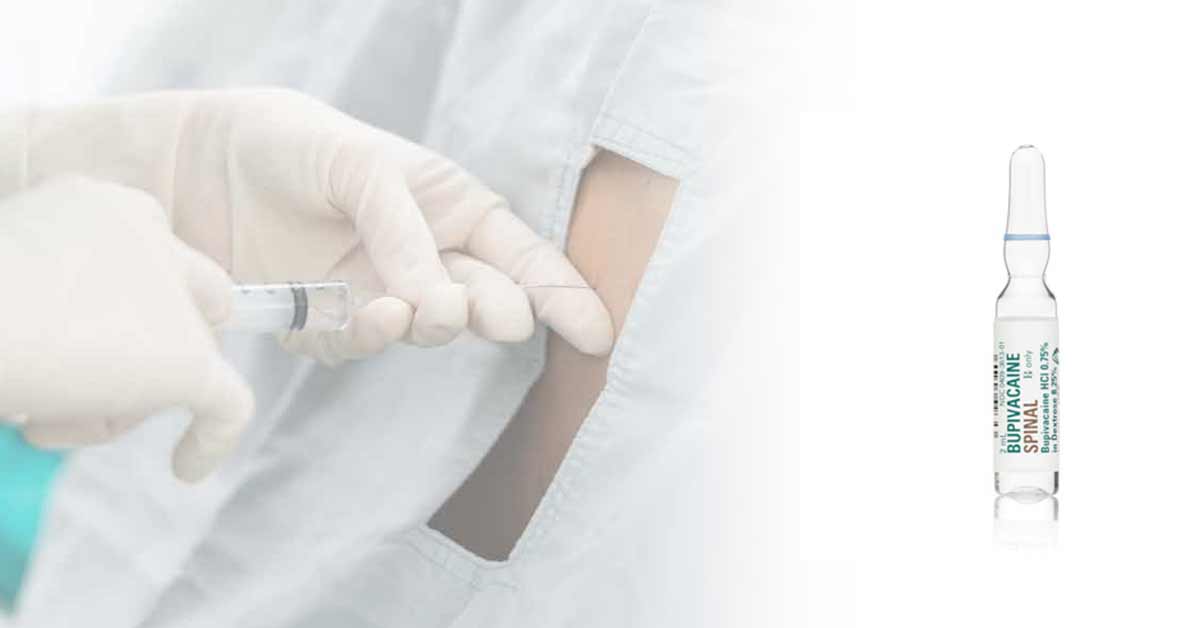
Marcaine Heavy (Bupivacaine Heavy) is an amide-type local anaesthetic drug given as an intrathecal anaesthetic. When given, it has a rapid onset and a medium to long duration depending on the dose.
Local anesthetics generally block the generation of the action potential in nerve cells by increasing the threshold for electrical excitation. They are used in regional anesthesia, epidural anesthesia, spinal anesthesia, and local infiltration.
Marcaine heavy is a a sterile, hyperbaric solution which is clear, colourless and particle-free, with a specific gravity of 1.026 at 20°C. The pH has been adjusted to 4.0 to 6.0.
Marcaine heavy hyperbaric and the initial spread in the subarachnoid space is affected by gravity. The duration of anaesthesia tends to be shorter due to the larger intrathecal distribution and the consequently lower mean concentration.
Due to the small dose, the intrathecal spread results in a relatively low concentration, and the duration of action of local anaesthesia tends to be relatively shorter.
Bupivacaine heavy is available in 0.25% (2.5mg/ml), 0.5% (5mg/ml), and 0.75% (7.5mg/ml) concentrations. The shelf life of bupivacaine is 3 years.
Composition of Marcaine Heavy:
Marcaine Heavy contain the main active ingredient, Bupivacaine hydrochloride. The excipients in the marcaine heavy include:
- Glucose monohydrate
- Sodium Hydroxide for pH adjustment
- Hydrochloric acid for pH adjustment
- Water for injections
Mechanism of Action
Bupivacaine causes a reversible blockade of impulse propagation along nerve fibres by preventing the inward movement of sodium ions through the nerve membrane. Amide-type local anaesthetic agents act within the sodium channels of the nerve membrane.
It has rapid onset of action but medium to long duration depending on the dose. It is approximately four times more potent and toxic that lignocaine.
Marcaine heavy produces moderate muscle relaxation in the lower extremities that last for 2-3 hours. Motor blockade of the abdominal muscles makes the solution suitable for performance of abdominal surgery lasting 1.5-2 hours. The duration of motor blockade does not exceed the duration of analgesia.
During spinal anaesthesia, there may be all in blood pressure and/or intercostal paralysis. This may be due to use of excessive doses, improper positioning of the patient or due to sympathetic blockade.
Pharmacokinetic Properties
Bupivacaine has a pKa of 8.2 and partition coefficient of 346 (25° С, n- octanol/phosphate buffer, pH 7.4). The metabolites possess pharmacological activity which is lower than that of bupivacaine. It is extensively bound to the plasma proteins (95%). It has high lipid solubility. These properties explain its long duration of action.
The maximum plasma concentration is approximately 0.4 mg/L for every 100 mg injected, due to slow absorption from the subarachnoid space and the small dose needed for spinal anaesthesia. Even the maximum recommended dose (20 mg) result in plasma levels of less than 0.1 mg/L.
The total plasma clearance is 0.58 L/min, a volume of distribution at steady state is 73 L, and elimination half-life is 2.7 hours. Liver metabolism is the major form of clearance, and only 6% of bupivacaine is excreted.
Clinical Indication
- Marcaine heavy is used in intrathecal (subarachnoid, spinal) anaesthesia for adults and children of all ages.
- For lower abdominal surgery like Caesarean section, lasting 1.5 to 3 hours
- For urological and lower limb, including hip surgery, that lasts 1.5 to 3 hours.
Dose and Administration:
Bupivaine is administered through local infiltration (post-surgical analgesia), peripheral nerve blocks (dental or other minor surgical procedures, orthopedic surgery), spinal anesthesia (injected into the CSF to produce anesthesia for orthopedic surgery, abdominal surgery, or cesarean delivery), epidural anesthesia for labor pain, and caudal block (anesthesia and analgesia below the umbilicus, mostly for pediatric surgery).
Marcaine heavy can be used in children and neonates. A larger dose/kg, is needed in children to produce the same effect as in adult because there is a relatively high CSF volume in infants and neonates.
Also, small children have less nerve myelination, facilitating diffusion and resulting in a faster anaesthesia effect.
The dosing for bupivacaine for children:
- < 5 kg: 0.40-0.50 mg/kg (dosage)
- 5 to 15 kg: 0.30-0.40 mg/kg (dosage)
- 15 to 40 kg: 0.25-0.30 mg/kg (dosage)
The spread of anaesthesia obtained with marcaine heavy depends on the volume of solution and the position of the patient during and following the injection.
Contraindications
- Allergy or hypersensitivity to amide type local anaesthetics, and the excipients.
- Uncorrected hypotension, cardiogenic or hypovolaemic shock
- Spinal stenosis and active disease (e.g. spondylitis, tuberculosis, tumour) or recent trauma (e.g. facture) in the vertebral column.
- Acute active diseases of the cerebrospinal system including meningitis, tumours (primary or secondary), poliomyelitis, subacute combined degeneration of the spinal cord, cranial haemorrhage, demyelinating disease and raised intracranial pressure.
- Inflammation and/or sepsis in the region of the proposed injection or in the presence of septicaemia.
- Coagulation disorders or when taking anti-coagulation treatment.
- Cardiogenic or hypovolaemic shock.
- Pernicious anaemia with subacute combined degeneration of the spinal cord.
- Pyogenic infection of the skin at or adjacent to the site of puncture.
- Due to difficulty in performing spinal anaesthesia in patients with arthritis and other diseases of the vertebral column, bupivacaine may not be used.
Drug Interactions
- Anti-arrhythmic drugs such as lidocaine, mexiletine and tocainid are structurally related to bupivacaine and may cause additive systemic toxic effects. Caution is necessary when using them together.
- Combining bupivacaine and propofol may increase the hypnotic effect of the propofol.
- Cimetidine reduces the clearance of bupivacaine with a reduction in dosage as a possible consequence
- Combining bupivacaine and verapamil together may result in an increased risk of a heart blockage
- Using bupivacaine and ACE inhibitors together may result in bradycardia and hypotension with impairment of consciousness as a consequence.
Pregnancy / Lactation
There is no report of any reproductive disturbances or malformations with the use of bupivacaine in pregnancy. However, the dose should be reduced in the late stages of pregnancy.
Related Posts:



Marcaine heavy enters breast milk in such small quantities that will not cause any risk to the baby.
Adverse Effects of Bupivacaine
Common adverse effects include cardiac disorders (hypotension, bradycardia), gastrointestinal disorders (nausea and vomiting), nervous system disorders (postdural puncture headache), urinary disorders (urinary retention, urinary incontinence).
Less common adverse reactions include nervous system disorders (paraesthesia, paresis, dysaesthesia), musculoskeletal, connective tissue and bone disorders (muscle weakness, back pain).
In rare occasions, especially in extensive (total) spinal blockade, patient may witness crdiac disorders (cardiac arrest), immune system disorders (allergic reactions, anaphylactic shock), nervous system disorders (total spinal block (unintentional), paraplegia, paralysis, neuropathy, arachnoiditis, and respiratory disorders (respiratory depression)
Precautions
- Bupivacaine heavy should be stored at 25°C or below. Do not freeze
- Spinal injections should only be made after the subarachnoid space has been clearly identified by lumbar puncture. The injection is given after the clear cerebrospinal fluid (CSF) is seen to escape from the spinal needle or it is detected by aspiration.
- Do not re-autoclave ampoules of marcaine heavy as incorrect autoclaving causes decomposition of glucose reducing the duration of anaesthesia of the hyperbaric solution.
- The solution must be protected from light
- Discard if there is discoloration of he product
- The solution is for single use, and any unused portion should be discarded
- Local anaesthetic agents may react with certain metals such as metal bowls, cannulae and syringes with metal parts after long exposure. Long contact with such metals should be prevented.
References:
- https://www.medicines.org.uk/emc/product/11160/smpc#gref
- https://anesthguide.com/topic/local-anesthetics-toxicity-maximum-doses/
- www.medsafe.govt.nz/profs/datasheet/m/MarcainSpinalinj.pdf