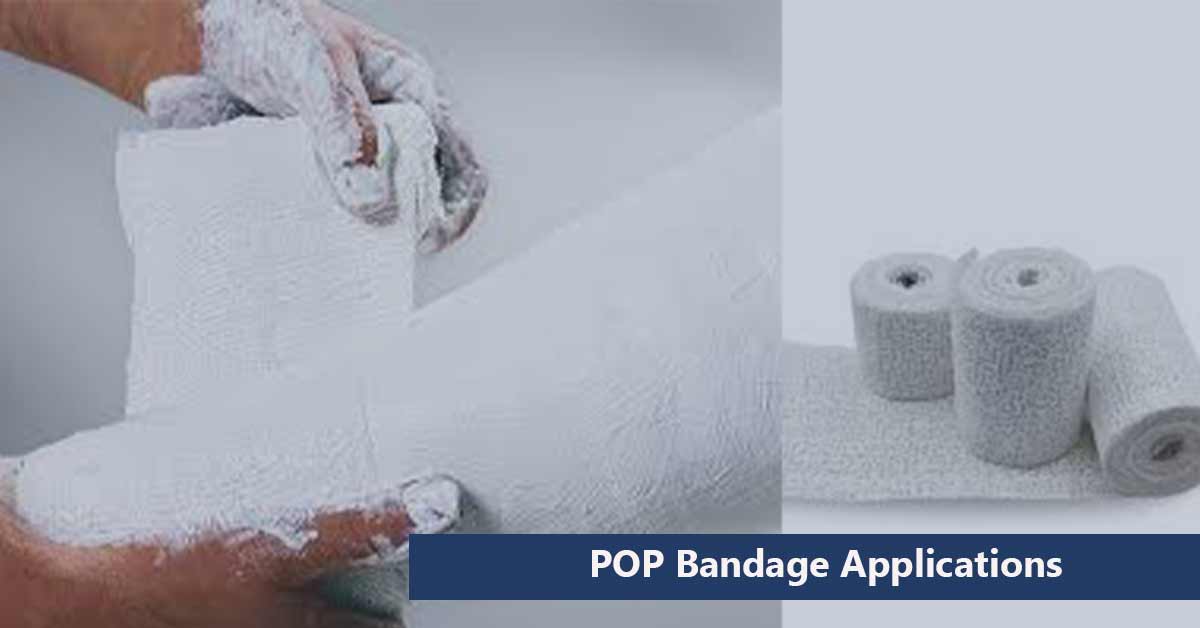
A Plaster of Paris bandage consists of a piece of muslin stiffened by dextrose or starch and impregnated with hemihydrate of calcium sulfate. It is then soaked in water and wrapped around one foot where it dries and hardens, forming a plaster cast. Plaster of Paris incorporates 20% of the water it soaks up, the remaining 80% is lost through drying.
Plaster of Paris bandage was first used over 150 years ago to treat fractures. Antonius Mathijsen, a Dutch military surgeon applied it in 1852.
It has since become a mainstay in the non-operative management of musculoskeletal injuries and immobilization conditions. The durability and firm cast-formation means it is favoured over other options.
Medical tapes and bandages are used in burns, trauma, and accident victims for mold-making and casting in treating fractures. The bandage is covered with plaster around the damaged area, holding the area together before it recovers.
The process of making the bandage involves applying gypsum paste on a cotton gauze. A portion of the coating is converted to plaster of Paris by dehydration. It is then rolled and cut into the desired shape.
The material in the bandage is not a known allergen, but if there are allergic reactions like itchiness or rashes, the use of the bandage should be discontinued.
Composition
Plaster of Paris Bandage consists of leno-weave bleached cotton gauze impregnated evenly with calcium sulphate that has been dehydrated so that it consists of mainly hemihydrate. Adhesives and setting-time modifiers may be added.
Unmodified plaster sets about 10 minutes after mixing, and completes after 40 minutes. The cast is fully dry after 72 minutes.
The plaster should be a fairly wide mesh starch free crioline or muslin bandage, 6 inch (15.2cm) wide and 4.6 meter long. A completed plaster bandage is elastic and springy.
Sizes of Plaster of Paris Bandages
| Bandage (Width x Length) | Body Application |
| Narrow roll (5 cm x 2.7 m to 5 m) | Fingers, toes, and pediatric limbs |
| Medium roll (7.5cm x 2.7 m to 4.5 m) | Wrists, hands, and smaller limbs |
| Standard roll (10 cm x 2.7 m to 5 m) | Adult arms, ankles, and lower legs |
| Large roll (15 cm x 2.7 m to 5 m) | Larger joints, lower legs, and thighs |
| Extra-large roll (20 cm x 2.7 m to 5 m) | Thighs, chest, and large torso, complex splinting |
Orthopedic Indications for Plaster of Paris Bandage
- It support the fractured bones, and control movements of the fragments and resting the damaged tissues
- To stablise and rest joints in ligamentous injury
- To support and immoblise joints and limbs until healing has occurred
- To ensure rest of infected tissues
- It is use to correct a deformity
- To make negative mould of a part of body
Different Types of Plaster Cast
Based on application, the different types of plaster cast include:
- Slab: Only a part of circumference of limb is incorporated
- Cast: The whole circumference of the limb is incorporated. We have short leg cast, long leg cast, and leg cylinder cast.
- Spica: The trunk and one or more limbs is incorporated. ex: hip spica
- Brace: splintage which can allow motion at adjacent joints based on interposition of materials.
Based on the interposition of materials, we have:
- Unpadded: An old practice where no material interposed in between the POP and skin
- Padded: The current form of practice where a material is interposed. The material may be stokinette and wool or wool alone.
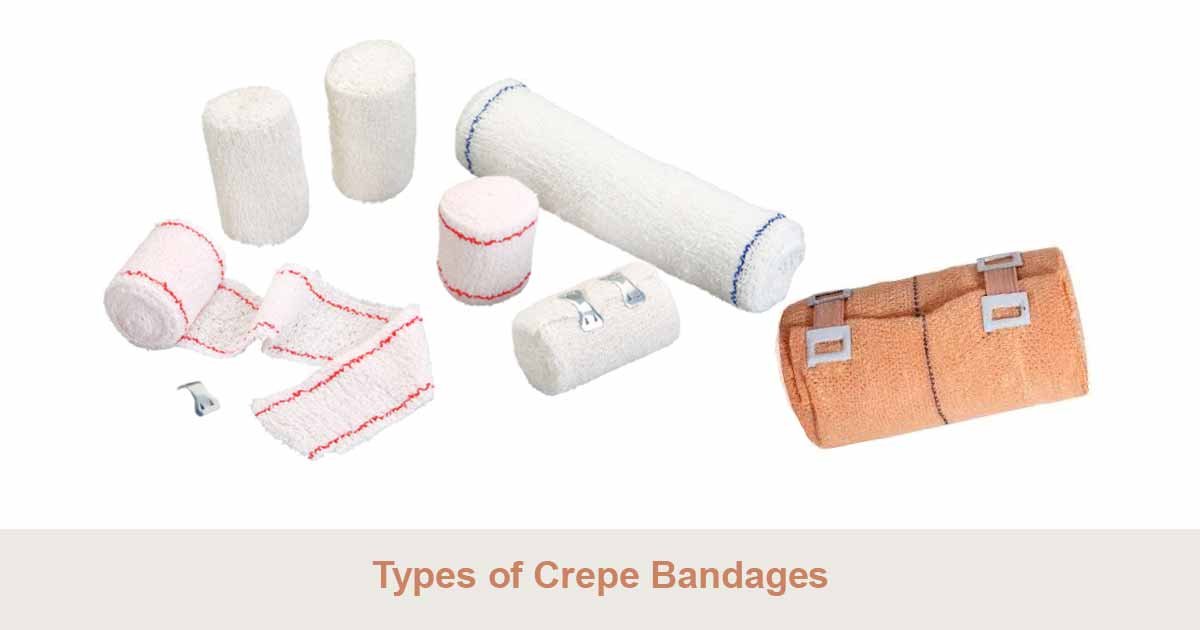
- READ ALSO: Different Types of Crepe Bandages Explained
How to Apply the Cast
To prepare the plaster of Paris bandage, use a dry cotton gauze (muslin) bandage, 500 cm long and 15 cm wide. Use a dry table with a smooth top to unroll a portion of the bandage and evenly apply plaster powder (anhydrous calcium sulphate or gypsum) to the surface.
- Clean the skin and dress any wound. You can apply stockinet, if available to the extremity, avoiding wrinkles. Then apply a cotton padding of uniform thickness over the stockinet while adding extra padding over any bony parts of the body such as the patella, the elbow or the ankle.
- Soak the plaster roll in a pail containing water at room temperature. Allow the plaster to soak in water to completely soak. Avoid warm water as the heat given off by the plaster when setting may burn the patient.
- Gently pick up the ends of the bandage using both hands and lightly squeeze it, pushing the ends together without twisting or wringing.
- Hold the relevant part of the body steady in the correct position when applying the plaster. Work fast and without interruption so that the plaster forms a homogenous mass.
- Apply the plaster by unrolling the bandage as it rests on the limb. Do not lift it up from the patient or apply tension to the roll. Overlap the previous layer of plaster by about half the width of the roll.
- Mould the plaster evenly around the bony prominences and contours. Leave 3 cm of padding at the upper and lower margins of the cast protecting the skin from irritation by the edge of the cast.
- Mould the cast until the plaster sets and becomes firm. Since the cast takes up to 24 hours to dry completely, advise the patient to take care not to dent the cast or apply weight to it during this time.
How to Remove a Plaster of Paris Bandage
The removal of Plaster of Paris bandage is done in a careful way to minimize the risk of injury.
- Use protective gloves, cast saw, and scissors
- With the cast saw, cut along the length of the cast. The cast saw will only vibrate rather than spin, hence preventing the cutting of the skin. A scissors is an alternative if there is no cast saw. You have to be careful to avoid skin contact.
- After cutting the cast, spread the edges gently apart to release the limb. The padding under the plaster may also be cut.
- Remove the cast slowly and gently off the limb. Do not use force to avoid injury.
- Clean the skin using mild soap and water to remove any residue. Observe if there is skin irritation or sores.
Proper Packaging
- The bandage shall be wound on a suitable core to allow wetting of the inner layer of the bandage when immersed in water prior to application.
- Polyethylene or suitable film bag is used to seal the rolls to prevent moisture ingress.
- Appropriate container is used to pack them to prevent damage during transportation.
Precaution
- The product is made for single-use, after which it is discarded.
- Do not use it if the product is damp or mouldy.
References
- https://www.advancingnortheast.in/wp-content/uploads/2021/10/Plaster-of-paris-bandages.pdf
- https://www.ticarehealth.com/everything-you-need-to-know-about-plaster-of-paris-bandage_n86
- https://www.kvcn.edu.in/wp-content/uploads/2019/11/plaster-of-paris-19.06.19.pdf
- https://www.who.int/docs/default-source/integrated-health-services-(ihs)/csy/surgical-care/imeesc-toolkit/best-practice-safety-protocols/casts-and-splints.pdf?sfvrsn=c18eb740_5